
- Details
- Written by: Adekunle Agbetiloye and sourced by Moses Mbano
- Hits: 237
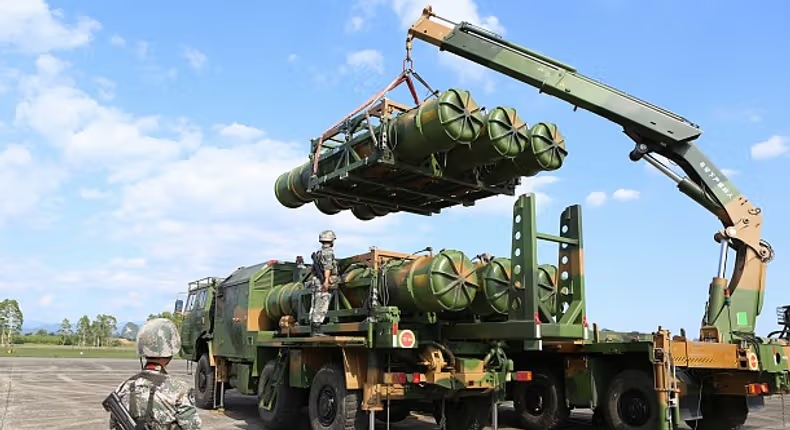 EU refuses to sell weapons to Zimbabwe as 24-year-old arms ban is extended
18 February 2026 10:13 AM
africa.businessinsider.com/arms-ban-is-extended
The EU has extended its arms embargo on Zimbabwe for another year, now lasting until February 2027. Sanctions were first imposed in 2002 due to serious human rights violations under former president Robert Mugabe. The embargo bans the export or technical assistance related to military equipment to Zimbabwe. Despite EU and US sanctions, Zimbabwe has turned to China and Russia for arms, with China supplying over a third of its major weapons imports since 1980.
The bloc first imposed sanctions in February 2002 over serious human rights violations under the government of former President Robert Mugabe, including restrictions on freedom of expression, association, and peaceful assembly. Mugabe stepped down following a military intervention in 2017 and died two years later. Under the measures, it is prohibited to grant, sell, supply or transfer military equipment or related technical assistance to Zimbabwe. The embargo has been renewed periodically since 2004 and was due to expire on February 20, 2026, before the latest extension.
In a statement, the European Council said the EU remains “constructively engaged” with Zimbabwe and hopes to deepen bilateral relations, particularly in trade and investment.
Most targeted measures lifted
- The council added that asset freezes and travel bans are no longer in force because no individuals or entities remain designated.
- Zimbabwe Defence Industries, previously the last entity on the sanctions list, was removed last year.
- The United States has taken a tougher stance, placing President Emmerson Mnangagwa on its Global Magnitsky sanctions list in 2024 over alleged abuses following his disputed election victory, Bloomberg reported.
Diversified arms sources beyond the West
Because of the restrictions, Zimbabwe has sourced military equipment from other partners. China has been one of its most prominent suppliers, accounting for more than one-third of the country’s major weapons imports between 1980 and 2009. In 2023, Beijing donated military equipment worth 200 million yuan ($28 million) to support security operations and modernise the armed forces. Russia has also emerged as a supplier, providing arms, ammunition and spare parts, with notable import values recorded in recent years.
- Details
- Written by: Chief Nhlanhlayamngwe Ndiweni & John Burke
- Hits: 307

No, this is not a new war, or a new G20 policy newsflash - but it is an onslaught of sorts - from our local "Yellow Dwarf" - Our Sun. A very large solar flare is on its way to Earth and NOAA scientists have produced this intensity map - and Zimbabwe is right in the middle!
So expect radio and GPS interference, mobile disruptions etc. see Dailymail - 11th Nov 2025
The sun erupted in a massive solar flare, the largest of the year, sending a wave of solar activity that could affect Earth starting on Tuesday. A powerful X5.1-class flare, capable of disrupting satellites, high-frequency radio and high-altitude flights, burst from the sun today. The flare caused a radio blackout across Europe and Africa around 5am ET, briefly affecting aviation, maritime, emergency, GPS, radar and satellite communications.
Space scientist Steph Yardley described the solar activity as 'not very common,' noting these extremely energetic particles from the sun are so strong that ground-based detectors can pick them up. 'There have been 75 recorded since 1942,' she posted on X. NOAA scientists are monitoring a possible coronal mass ejection (CME), a huge cloud of solar material and magnetic fields, moving at about 3,000 miles per second.
If it is headed for our planet, it could trigger a strong geomagnetic storm, disturbing Earth’s magnetic field overnight into Wednesday. If it is headed for Earth, it could trigger a strong geomagnetic storm, disturbing Earth’s magnetic field overnight into Wednesday. Auroras may appear as far south as Pennsylvania, Iowa, and Oregon. Power grids, GPS navigation, and HF radio communications could all be affected, NOAA shared in an alert.
- Details
- Written by: Shorayi Spencer Guzha
- Hits: 641
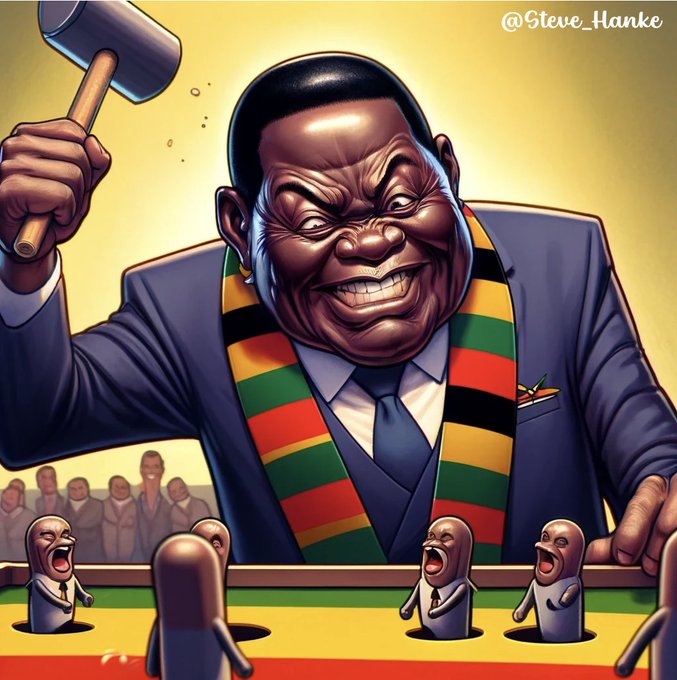 ZANU‑PF at the Helm:
Power, Abuse and Systemic Corruption
Human Rights Abuses
Independent monitoring by the Zimbabwe Peace Project (ZPP) consistently identifies ZANU‑PF as the leading perpetrator of rights violations. In June 2024, ZANU‑PF was responsible for 65% of all recorded violations, with total incidents reaching 137 cases, including assaults, forced participation in political events, and intimidation. Earlier in the year, February saw 188 reported violations, 54.8% attributed to ZANU‑PF action. Civil society and opposition figures are routinely targeted via arrests, prosecutions on trumped-up charges, and violence, tools used by the regime to quell dissent.
Corruption and Crony Capitalism
Corruption is deeply entrenched in Zimbabwe’s political economy. Transparency International ranked Zimbabwe at 21/100 on its 2024 Corruption Perceptions Index: 158th of 180 countries. State institutions, including the judiciary and police, have been repurposed to serve party interests. High-profile scandals include the Command Agriculture fraud, a COVID‑19 mask scheme, and a cancer‑machine contract, all tied to ZANU‑PF officials or associates. Notably, Kudakwashe Tagwirei, a close associate of President Mnangagwa, is sanctioned by the US and UK for exploiting political connections to profit from state contracts and foreign currency deals. Wicknell Chivhayo and many others are benefiting from corruption at the expense of the starving citizens.
- Details
- Written by: John Burke
- Hits: 635
 We asked:
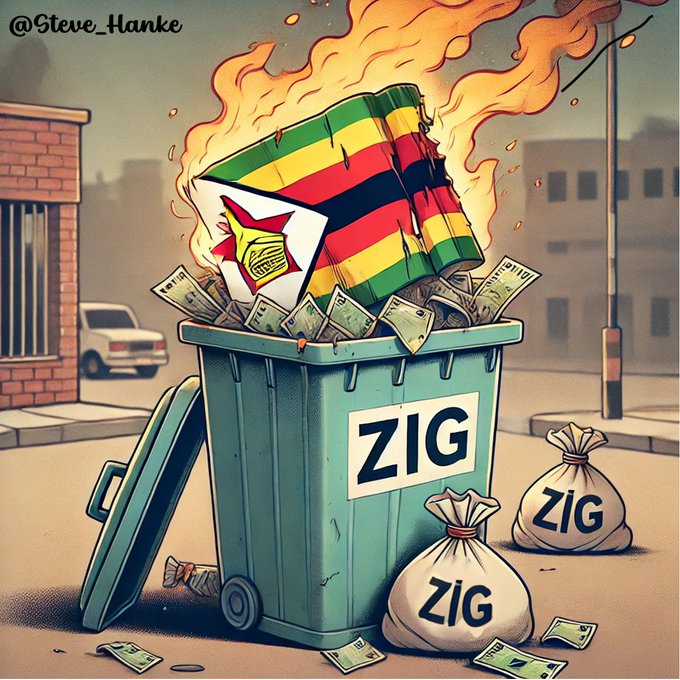
Within the last 45 years since Zimbabwe's independence (18th April 1980) has Zanu PF simply morphed into a new type of Black Colonialists? How has Zimbabwe become "enriched" under the corrupt Zanu PF regime?
AI Deep Research Constructed the reply below:
Since Zimbabwe’s independence on April 18, 1980, ZANU-PF (Zimbabwe African National Union – Patriotic Front) has been the dominant political force, ruling continuously for the past 45 years.
The question of whether ZANU-PF has morphed into a new type of "Black Colonialists" hinges on comparing their governance to colonial exploitation, where a minority elite subjugates and extracts wealth from the majority. As for how Zimbabwe has become "enriched" under their rule, this likely probes whether the country—or specific groups within it—has benefited materially or otherwise, despite widespread corruption allegations.
ZANU-PF’s trajectory suggests a shift from its liberation roots to a system where power and resources are concentrated among a loyal elite, resembling colonial dynamics in some ways. After independence, Robert Mugabe’s initial reconciliation rhetoric aimed to unite a fractured nation, integrating ZANU-PF, ZAPU, and even white Rhodesians into government. However, the 1980s Gukurahundi campaign—where the North Korean-trained Fifth Brigade killed an estimated 20,000 mostly Ndebele civilians in Matabeleland—marked an early turn toward authoritarian control, sidelining ZAPU and enforcing ZANU-PF dominance. The 1987 Unity Accord merged ZAPU into ZANU-PF, creating a de facto one-party state, a move critics argue prioritized power over pluralism.
Economically, ZANU-PF inherited a robust system—once dubbed the "breadbasket of Africa"—with a GDP growth rate of about 5% annually pre-independence. Yet, over decades, policies like the 2000 Fast Track Land Reform dismantled this. While intended to redistribute land from white farmers (0.6% of the population holding 70% of fertile land) to black Zimbabweans, it often enriched party loyalists—war veterans, cronies, and elites—rather than the broader population. Agricultural output crashed, exports dwindled, and hyperinflation hit, peaking at 79.6 billion percent monthly in 2008. The rural poor gained some land, but productivity tanked due to lack of support, while urban decay and unemployment soared. Life expectancy dropped from 68 in 1980 to 34 by the early 2000s, reflecting collapsed healthcare and living standards.
Corruption has been a hallmark, with scandals like the 1980s Paweni Scandal, the 1987 Zisco Steel fiasco, and recent US-sanctioned dealings involving Emmerson Mnangagwa, VP Constantino Chiwenga, and businessman Kudakwashe Tagwirei. The elite—military brass, party officials, and connected tycoons—amassed wealth through mining (gold, diamonds), fuel deals, and state contracts, often via opaque firms like Tagwirei’s Sakunda Holdings. Meanwhile, 50% of Zimbabweans live in abject poverty today, a stark contrast to the colonial era’s white minority privilege, but now with a black ruling class as the beneficiaries.
Has ZANU-PF become "Black Colonialists"? The colonial parallel fits in their extraction of wealth for a minority while suppressing dissent—elections since 2000 are widely criticized as rigged, with violence (e.g., 2008’s Operation Mavhoterapapi) mirroring colonial coercion. Yet, unlike colonialists, ZANU-PF’s legitimacy rests on its anti-colonial struggle, a narrative it wields to justify control, even as it alienates the masses it once claimed to liberate.
"Enrichment" under ZANU-PF is lopsided. The nation’s formal GDP shrank from a potential $52 billion (if 5% growth had held) to $14 billion by 2016, per Zimbabwe News estimates. However, the party elite and their networks have grown rich—mansions in Harare’s Borrowdale Brooke, stakes in Marange diamond fields, and offshore accounts tell the tale. For ordinary Zimbabweans, any enrichment is survivalist: small-scale farming on redistributed land or informal trading amid economic ruin. Education, a post-independence bright spot (90.7% literacy by 2013), has eroded with underfunded schools, though it remains a legacy of early ZANU-PF investment.
In sum, ZANU-PF’s 45-year reign has echoes of colonial exploitation—power and profit for a few, stagnation for most—cloaked in liberation rhetoric. Zimbabwe’s "enrichment" is real but selective, a veneer of progress atop a hollowed-out state.
- Details
- Written by: Michelle Mudzviti
- Hits: 649
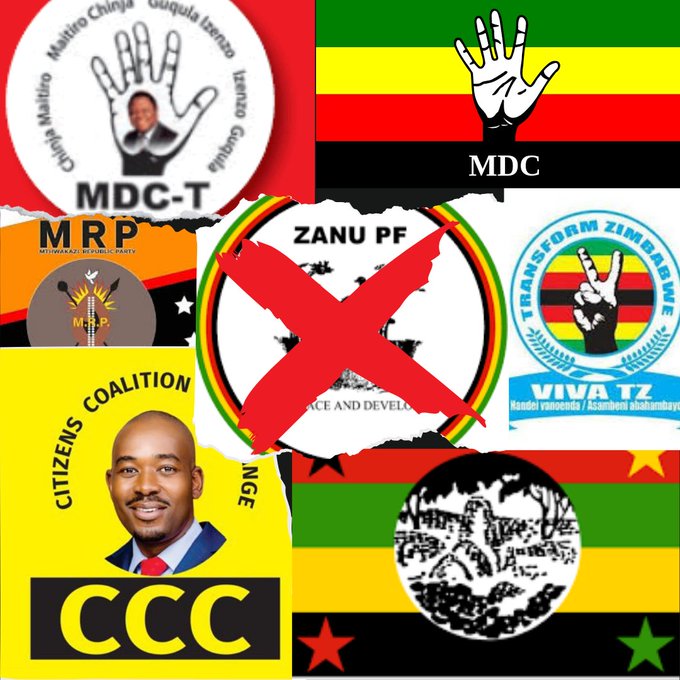 The 'Solution' to Zimbabwe's Fractured Opposition Politics Problem
The Zimbabwean people have suffered enough from a fractured opposition. The cycle of electioneering distracts Zimbabwe’s leadership from the urgent task of economic recovery, as they focus instead on factional power plays. It is time for us to put the past behind us and our differences aside and focus on the bigger picture. The stakes are high, and the next election will decide whether we continue on the path of decline or whether we take a bold step towards restoring democracy, dignity and economic freedom for the citizens of Zimbabwe.
I would like to present a proposal for a practical and fair path forward, one that prioritizes the will of the people, creates space for all leaders to demonstrate their abilities, and ensures we select the strongest candidate to represent the unified coalition in the next election.
Given the urgency of the situation and the need to act decisively against a ruling party that is already organizing, the opposition must prioritize unity, strategic action, and effective mobilization to capitalize on the limited time available before the next election.
1. Form a Unified and Clear Coalition
Instead of lengthy debates about who is fit to lead a united opposition in Zimbabwe at the moment, the opposition should work quickly to form a unified coalition with clear, actionable goals. The issue of leadership will be addressed at a later stage (see point 5 below). What is most crucial right now is for the leaders of the different factions to demonstrate a willingness to put their differences aside for the greater good. Agree on a unified vision for the country, where key issues (e.g. economic recovery, corruption, national security) are prioritized.
- Details
- Written by: John Burke
- Hits: 561
 Gukurahundi Genocide: Tragic Subject - Petition to the Prime Minister!
On Thursday 5th December 2024 we revisited the topic of the Gukurahundi Genocide, having previously done so on Thursday 19 July 2018 {CLICK FOR THE 2018 Petition} to the then Prime Minister Theresa May {CLICK FOR ARTICLE}- again in partnership with ZAPU members - who were the main "targets" of this heinous campaign. Ostensibly started in 1982 with the dismissal of Joshua Nkomo - from the fledgling Zimbabwe Government, upon the order of Robert Mugabe.
This time around, we congregated outside the newly "secured" Zimbabwe Embassy - they have got some grim looking metal security gated fabrications at the side and front entrances - to make the Embassy even less friendly or appealing to the Zimbabwean Diaspora - security concerns or Guilt? - we have to ask why these new gates - {photo on Flickr - click to see for yourself SIDE DOOR - 429 CORNER DOOR }.
True to form the guilty inside locked their doors - simply as we were there. Indeed they sent out a CIO to sit in his new BMW X6 to "observe us" - so we took their photos too - again on our Flickr Album of the day. {CLICK HERE TO SEE THE DAYS PHOTO ALBUM} Please note that due to technical constraints, the videos recorded today will take some considerable time to be 'compressed' in order to be displayed upon our Flickr Platform - so expect videos to be appearing by the weekend please.
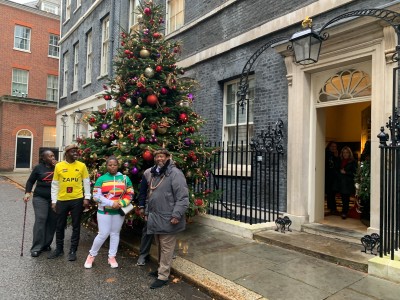
We took some more photos with our "Zanu PF Must Go" banner and by 13:30 we sidled off towards Trafalgar Square and onto Whitehall. by 13:45 we were arranged opposite Downing Street - under the gaze of "Monty" at his commemorative statue. By the time we have said our hellos to the new supporters opposite Downing Street it was time to present our band of 6 petitioners to the Diplomatic Police Unit in control of Downing Street. Ronald T Mutumbi, was due to be the Organiser of the 6 of us today - but had unexpected problems with travel on the day - such a pity.
So we 6 lined up at the solid security gates {making the Zimbabwean Embassy gates looking a little flimsy!} at the entrance to Downing Street. Our Police Diplomatic Unit Escort - was a friendly as any tourist guide - calling us in by our first names! As some may know within those gates we have to go through Air Port Quality X-Ray machines to check all our bags, mobile phones or any metal objects.